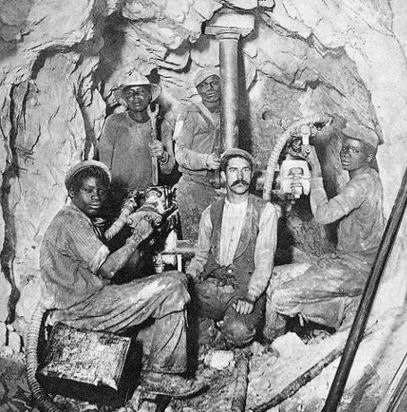
My final installment of Apartheid South Africa through the eyes of the I.B. History textbook has arrived. We begin with trade unions. They were formed in defiance of the law. The foremost among these was the African Mine Workers’ Union (A.M.W.U.) which organized a strike of about 100,000 gold miners in 1946. Unfortunately it was defeated when police intervened and killed nine protesters. The 1946 miners’ strike alerted the government to the urgency of the labor situation.
Smuts’s response was to set up the Fagan Commission. Fagan’s report concluded that the tide of African urbanization was irreversible and that it was in the best economic interest of the country for the government to bring about a partial normalization in status of the Blacks who lived in the cities. This recommendation included a relaxation of the pass laws. Fagan’s report formed the basis of the United Party’s policy manifesto going into the 1948 general election. This only heightened the racial anxieties of many White voters.
The National Party reacted by forming its own Sauer Commission. This body concluded that the survival of the White race in South Africa was dependent upon the preservation of the country’s exclusively White identity. According to Sauer, this could only be achieved through policies designed to reverse the trend of Black urbanization and engineer a complete separation of races.
The N.P.’s ability to articulate a clear apartheid vision contrasted sharply with the uneasy complexity of the U.P.’s position. Their message resonated with many Afrikaner voters in a fearful and embattled white electorate. The party’s slogan of swart gevaar “black peril” and rooi gevaar “red peril” raised twin spectres of white cities overwhelmed by migrant Black workers on the one hand and the civilized Afrikaner way of life threatened by a godless, revolutionary communism on the other. This was enough to see Malan’s N.P. triumph over its U.P. rival.